Richard Moynan: Irish artist and unionist propagandist

Eire-Ireland:Journal of Irish Studies, Spring-Summer, 2004 by Maebh O'Regan

IT IS A WELL-ESTABLISHED FACT that history is written by the victors, but it is less widely acknowledged that history is also painted by the victors. In Inventing Ireland, Declan Kiberd argues that the bloody Irish revolution of 1916-23 was preceded by a verbal battle, a primarily literary war of poetry, plays and songs designed to construct an indigenous Irish identity. According to Kiberd, this ideological clash prepared the way for the military and political struggle yet to come. (1) Artists played a key role in the formation of this new identity. Painters like Aloysius O'Kelly, Jack Butler Yeats and Sean Keating established images designed to ratify the nation's emerging identity. A new confidence was abroad, and the next generation of painters had, for the first time, nationalist artistic role models.

But there was another group of artists in Ireland, a cadre whose patriotism was no less fervent than those mentioned above, although their particular brand of patriotism was linked to a different set of political values. These were the traditionalists, painters whose art and unionist politics were closely connected with extant academic and economic values. These artists hailed predominantly from a Protestant, business-class background, and identified strongly with the metropolitan center. This essay examines one of the most prominent of these artists, Dublin-born painter Richard Thomas Moynan (1856-1905), an Irish artist who used his work to help forge stronger bonds with Britain and its empire.

Richard Moynan was born on 27 April 1856 at I Eldon Terrace, off the South Circular Road, Dublin. He was fourth of eight children; three sons and five daughters, born to Richard Moynan, Sr., and his wife Harriet Nobel. The painter's father held a managerial position with the fabric importers Ferrier, Pollock and Company, while his mother was the daughter of Arthur Nobel, a Church of Ireland clergyman. The younger Moynan initially studied medicine but, shortly before his final examinations, he changed tack and opted instead for a career in the arts, commencing his training at the Dublin Metropolitan School of Art in the autumn of 1879.

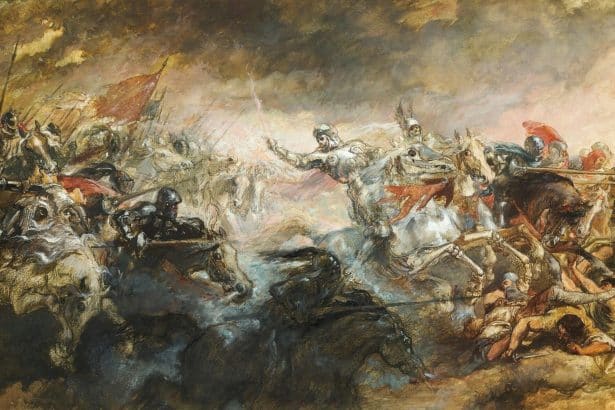
Moynan achieved early success within the art school system. More mature than his fellow students in terms of age and education, he won prizes in both the Taylor and Cowper competitions. In 1882 he moved on to the Royal Hibernian Academy, where he won both silver and bronze medals for his work, crowning these achievements the following year with the Albert Scholarship for the best picture shown in the Royal Hibernian Academy by a student. (2) This painting, The Last of the 24th at Isandula (RHA, 1883), portrayed an episode in the Zulu wars, providing an early indication of the artist's unionist outlook, a characteristic evident throughout his career.

Following the example of fellow Irish painters Walter Osborne, Nathaniel Hill, and Joseph Malachy Kavanagh, Moynan enrolled in Academie Royale des Beaux Arts in Antwerp in October 1883. His Dublin colleagues Roderic O'Conor and Henry Allen registered for the same course. The intensity of his studies was such that, for the first time in four years, he did not contribute to the Royal Hibernian Academy exhibition. Moynan instead focused on preparing for the most important competition in the Academie, the annual concours. This approach yielded the desired results, and he gained the highest accolade, attaining first place in painting from the living model. He was the first Irishman to achieve such an award. This prestigious prize paid immediate dividends, ranking him among the elite. It allowed him the privilege of special tuition from Professor of Painting Karl Verlat (1824-90), as well as extra studio space, facilitating the painting of the human figure in life scale. This success influenced his decision to remain in Antwerp for a further year. But affairs of the heart also had to be settled, and he returned to Ireland immediately after the concours and married his cousin, Suzanna Mary Moynan, in her home in Thurles on 9 April 1884.

Moynan spent another year at Antwerp, where he produced a number of works depicting group interiors such as The Reading Lesson (1884), Girls Reading a Newspaper (1885), The Laundress (1885), and What does it want? (1885-86). These canvasses are painted in a highly academic style, rendering architectural features, furniture, and textiles in great detail, with particular reference to the Dutch seventeenth-century tradition. Ever anxious to broaden his artistic experience, Moynan moved on to Academie Julian in Paris in 1886. His sojourn in the French capital facilitated the use of a lighter palette, looser brushstrokes, and a brief flirtation with the "square brush technique."

The artist returned to Dublin in the winter of 1886, where he set up practice as a professional painter. Conscious of the importance of networking, he joined a number of artistic associations, becoming a committee member of the Dublin Art Club and president of the Dublin Sketching Club (1889) while continuing to exhibit in the Royal Hibernian Academy. He consolidated this position by becoming a member of the Grand Lodge of Freemasons. Works dating from this period demonstrate his ability to imaginatively interpret the role of the artist in society. The 1887 painting, We hope we don't intrude (National Gallery of Ireland, hereafter NGI), shows the painter in his studio in Harold's Cross welcoming a group of ladies into his small, well-equipped work place. This theme is reinforced in Taking Measurements (NGI, 1887), which depicts the artist sketching a cast of a lion from the Mausoleum in Halicarnassus in the hall of the National Gallery of Ireland.


BNET TalkbackShare your ideas and expertise on this topic

Please add your comment:

  1. You are currently: a Guest |
  2.  

Basic HTML tags that work in comments are: bold (<b></b>), italic (<i></i>), underline (<u></u>), and hyperlink (<a href></a)

advertisement
advertisement
  • Click Here
  • Click Here
  • Click Here
advertisement

Content provided in partnership with Thompson Gale