The Hidden Unity Of Hearts - the evolution of the human heart

Natural History, April, 2000 by Carl Zimmer

Every second or so of every minute of every hour of every day, something remarkable happens inside your body. The valves of your heart open, blood surges into its chambers, the heart contracts, and then blood comes blasting out, either to load up with oxygen in the lungs or to flow into the rest of your body. Every beat of your heart is the result of a precise choreography of electrical impulses and swirling fluids, a choreography without which you'd be dead in minutes.

Over the past several years, scientists have gone a long way toward figuring out how this complex and vital organ evolved. By comparing the hearts of living animals and unlocking the genes that build them, they have found that while there may be no physiological truth to the expression "my heart is in my throat," that may be exactly where hearts began. They've also discovered that the change from simple tube to complex, chambered organ may have happened in an evolutionary flash.

The first foreshadowings of the heart reach back to at least 800 million years ago, when the first known multicellular fossils formed. A single cell can draw in oxygen and nutrients through its membrane, but once cells start huddling together, some will be cut off from the outside world. Cells can pass nutrients to one another across their membranes, but it's a slow process that works only over tiny distances. An animal of any size needs a plumbing system.

You can find a simple (though elegant) version of plumbing in sponges, which are among the most primitive animals on the planet. The sponge is shot through with tunnels that branch into smaller and smaller tunnels. Lining the tunnels are cells with little hairs that wave back and forth, pumping water through the organism at a tremendous rate; as the water flows past, the cells extract oxygen from it and filter out particles of food. These tunnels enable a sponge to bring seawater directly to all its cells, making it, in a sense, a multicellular animal trying to live a unicellular life.

But evolution later produced more complex animals, with cells that could no longer fend for themselves. The bodies of these more complex organisms have cells of many different types, each dedicated to its own specialized work. A photoreceptor cell in a squid's eye, for example, helps the squid see but doesn't feed itself. These animals need a circulatory system to replenish their cells, and they need something to keep that system pumping. You can find hearts, or heartlike structures, beating in the bodies of many complex animals, including mollusks, arthropods, and chordates (among which are vertebrates such as ourselves.) Yet few of these hearts, other than those of vertebrates, resemble our own.

A fly's heart, for instance, is a muscular tube that simply squeezes the insect version of blood (called hemolymph) into the body cavity, rather than being connected to a closed system of veins and arteries. The fly's heartbeat is somewhat like the peristalsis in your digestive tract: a simple ripple of contraction. Unlike flies (and more like us), the earthworm has a closed vascular system, but instead of a heart, it has eleven contracting vessels, each of which pumps much as a heart does. The octopus (a mollusk) has two powerful, chambered hearts, each pumping blood through a set of gills.

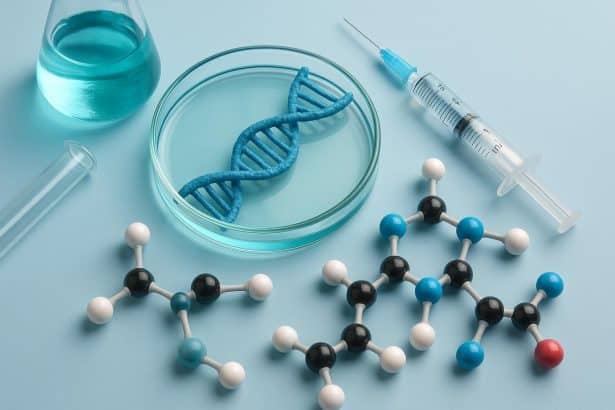
For decades, biologists assumed that all these hearts, which look so different from one another, had evolved independently. But in recent years, research on how genes orchestrate the development of hearts within embryos has revealed a hidden unity. In the laboratory, scientists alter or remove particular genes in animals and then look at the consequences in the developing embryo. The deformities that result from these experiments help the researchers figure out a particular gene's usual role in development.

Much of this work has been done on mice, which have the advantage of being closely related to humans but which have some drawbacks as well; for one thing, their embryos grow inside a uterus and are difficult to observe. Other experiments have involved organisms that are less closely related to us yet easier to study, such as vinegar worms and fruit flies. A major breakthrough came in 1993, when Rolf Bodmer at the University of Michigan discovered the gene that controls the development of the fruit fly heart; a fly that lacks this gene never forms a heart at all. The gene was named tinman, after the Tin Woodman in the Wizard of Oz, who joins up with Dorothy and sets off for the Emerald City to ask the Wizard for a heart.

Tinman belongs to a special class of genes. Many genes carry instructions for making a single protein that has a specific job--to build fingernails or make hemoglobin, for example. But some genes make proteins that control other genes. Some act like master switches, triggering many different genes to work together to build a structure. Tinman is one such "master gene" for the fruit fly. Within a few years of its discovery, scientists found master genes for building hearts--named, far less poetically, Nkx genes--in mice as well.


BNET TalkbackShare your ideas and expertise on this topic

Please add your comment:

  1. You are currently: a Guest |
  2.  

Basic HTML tags that work in comments are: bold (<b></b>), italic (<i></i>), underline (<u></u>), and hyperlink (<a href></a)

advertisement
advertisement
  • Click Here
  • Click Here
  • Click Here
advertisement
Click Here

Content provided in partnership with Thompson Gale