advertisement
On The Insider: Brooke Hogan to Pose for Playboy?
Find Articles in:
all
Business
Reference
Technology
News
Sports
Health
Autos
Arts
Home & Garden
advertisement
Click Here

Content provided in partnership with
Thomson / Gale

The five points of Lagrange: at some very special spots in the Earth-Moon gravitational system, all forces are in balance

Natural History,  April, 2002  by Neil deGrasse Tyson

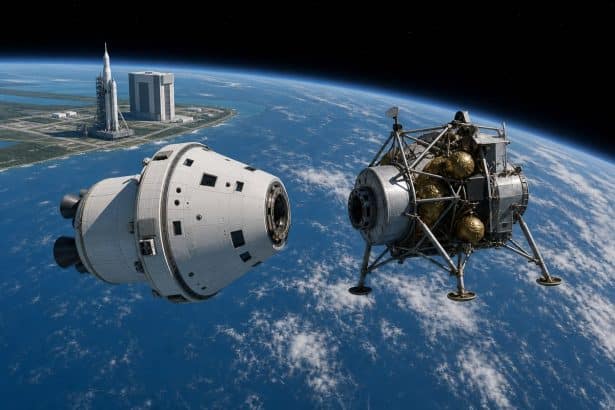
The first manned spacecraft ever to leave Earth orbit was Apollo 8. This achievement remains one of the most unappreciated firsts of the twentieth century. When that moment arrived, the astronauts fired the third and final stage of their mighty Saturn V rocket, and the spacecraft and its three occupants rapidly reached a speed of nearly seven miles per second. Half the energy needed to reach the Moon had already been expended just to achieve Earth orbit. At about the same moment, a well-known television news anchor declared that the astronauts had just left Earth's gravity. But the astronauts were on their way to the Moon. And last anybody had checked, the Moon was in orbit around Earth by the action of mutual gravitational forces. So Earth's gravity must extend at least as far as the Moon. Fact is, the force of gravity for any object extends to the infinite reaches of space, even as it grows ever weaker.

Most Popular Articles in Reference
The importance of understanding organizational culture
Credit card attitudes and behaviors of college students
What factors attract foreign direct investment?
Libraries Need Relationship Marketing - mutual interest marketing concept, ...
How to set performance goals: employee reviews are more than annual critiques
More »
advertisement

After the third stage fired, engines were no longer necessary except to tune the midcourse trajectory so that the astronauts did not miss the Moon entirely. For most of its nearly quarter-million-mile journey from Earth to the Moon, the spacecraft gradually slowed as Earth's gravity continued to out-tug the Moon's gravity. Meanwhile, as the astronauts neared the Moon, its force of gravity was growing stronger and stronger. Obviously, a spot must exist, en route, where the Moon's and Earth's opposing forces of gravity balance precisely. When the command module drifted across that point in space, its speed increased once again, and it accelerated toward the Moon.

If gravity were the only force to be reckoned with, then this spot would be the only place in the Earth-Moon system where the opposing forces cancel. But Earth and the Moon orbit a common center of gravity, which lives about a thousand miles beneath Earth's surface along the length of an imaginary line connecting the center of Earth to the center of the Moon. When objects move in circles of any size and at any speed, they create a new force that pushes outward, away from the center of rotation. Your body feels this "centrifugal" force when you make a sharp turn in your car or when you survive amusement park attractions that turn in circles. In a classic example of these nausea-inducing rides, you stand along the edge of a large circular platter, with your back against a perimeter wall. As the thing spins, rotating faster and faster, you feel a stronger and stronger force pinning you against the wall. It's the sturdy wall that prevents you from being flung through the air. Soon you can't move. That's when they drop the floor from below your feet and turn the thing sideways and upside down. When I rode one of these as a kid, the force was so great that I could barely move my fingers: they stuck to the wail along with the rest of me.

If you actually got sick on such a ride and you turned your head sideways, the vomit would fly off at a tangent. Or it might get stuck to the wall. Worse yet, if you didn't turn your head, it might not make it out of your mouth, owing to the extreme centrifugal forces acting in the opposite direction. (Come to think of it, I haven't seen this particular ride anywhere lately; I bet they've been outlawed.)

Centrifugal forces arise as the simple consequence of an object's tendency to travel in a straight line after being set in motion, and so are not true forces at all. But you can use them in calculations as though they were. When you do, as the brilliant French mathematician Joseph-Louis Lagrange (1736-1813) did, you discover spots in the rotating Earth-Moon system where the gravity of Earth, the gravity of the Moon, and the centrifugal forces of the rotating system all balance. These special locations are known as the points of Lagrange, and there are rive of them.

The first point of Lagrange (affectionately called L1) falls slightly closer to Earth than the point of pure gravitational balance. Any object placed at L1 can orbit the Earth-Moon center of gravity with the same monthly period as the Moon's orbit and will appear to be locked in place along the Earth-Moon line. Although all forces cancel there, L1 is a point of precarious equilibrium. If the object drifts away from the Earth-Moon line in any direction, the combined effect of the three forces will return it to its former position. But if the object drifts along the Earth-Moon line ever so slightly, it will irreversibly fall toward either Earth or the Moon. It's like a cart atop a mountain, barely balanced, a hair's width away from falling down one side or the other.

The second and third Lagrangian points (L2 and L3) also lie on the Earth-Moon line, but L2 lies far beyond the Moon, while L3 lies far beyond Earth in the opposite direction. Once again, the three forces--Earth's gravity, the Moon's gravity, and the centrifugal forces of the rotating system--cancel in concert. And once again, an object placed in either spot can orbit the Earth-Moon center of gravity in a lunar month.