advertisement
On The Insider: Brooke Hogan to Pose for Playboy?
Find Articles in:
all
Business
Reference
Technology
News
Sports
Health
Autos
Arts
Home & Garden
advertisement

Content provided in partnership with
Thomson / Gale

Secret Knowledge: Rediscovering the Lost Techniques of the Old Masters. - Vermeer's Camera - book review

Art in America,  April, 2002  by David L. Sweet

Secret Knowledge: Rediscovering the Lost Techniques of the Old Masters, by David Hockney, New York, Viking Studio, 2001; 296 pages, $60.

Vermeer's Camera, by Philip Steadman, New York, Oxford University Press, 2001; 232 pages, $25.

Unless you attended one of his public lectures, you probably first learned about David Hockney's new take on the history of Western painting from Lawrence Weschler's New Yorker article in January 2000, nearly two years before the publication of Hockney's book in the United States. Hockney, whose suave works chronicling the poolside hedonism of postscarcity society earned him a place at the forefront of the Pop and neo-realist movements of the 1960s and '70s, has come up with a feisty, provocative thesis. He claims that many of the great European masters probably used optical devices to facilitate the creation of their more meticulously naturalistic works. He also asserts that the use of what he calls "optics"--the projection of living images onto a flat surface via a lens or mirror--occurred much earlier than scholars previously suspected.

Most Popular Articles in Arts
Art since 1900: Modernism, Antimodernism, Postmodernism
Free-standing cardboard sculpture
What makes a successful business person? Business people who are tops in ...
Take advantage of local advertising: TV, newspaper or magazines? If your ...
Tino Sehgal at the ICA
More »
advertisement

Though many people are familiar with the notion that Jan Vermeer used a camera obscura to capture "photographic" effects in his Dutch interiors and cityscapes, few know exactly what the implement is. But even fewer would have ever considered the possibility that Ingres, Velazquez, Caravaggio, van Eyck or even Raphael may have had recourse to such a device as an aid to drawing and painting. Numerous art historians responded to Hockney's proposal with suspicious stupefaction, as if this avant-garde upstart were accusing the old masters of painting by numbers. The New Yorker piece itself ended on a note of skepticism, with John Walsh, then director of the Getty Museum, commenting that "nobody is expecting a killer theoretical tome from Hockney." (1)

In some ways, Walsh's prediction was correct; Hockney's new book is not deeply theoretical. But it is sensationally big and beautiful, seductive yet iconoclastic. Hockney has produced a large-format, 296-page volume complete with essay, correspondence, historical records and hundreds of reproductions of works ranging from the Ghent altarpiece to his own Pearblossom Highway photo-collage. And although the illustrations take up much of that bulk, Hockney has a lot to say here and gets substantial support from other experts. In this way, he snuffs out some of the earlier criticism that his thesis lacked documentation, but he also blunts his own insinuations that the majority of historians aren't looking hard enough at their primary sources, the paintings themselves. The project began as a direct assault on the methodological myopia of academics, yet a great deal of scholarly debate and even collaboration has gone into this book, with arguments pro and con contributed by art historians and museum curators such as Martin Kemp, David Graves, Gary Tinterow, Peter Sutton, John Spike, Svetlana Alpers, Susan Foister and Helen Langdon. The list even includes a professor of optical sciences, Charles Falco.

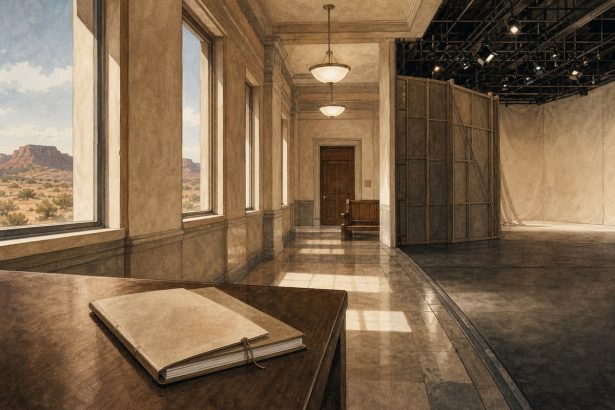

Another one of Hockney's correspondents is the British art historian Philip Steadman, who recently published his own book about optical devices, Vermeer's Camera, a study in which visual and documentary materials are closely scrutinized to show that the master of Delft probably did utilize a camera obscura from the late 1650s on. The volume both supports and contrasts with Hockney's in terms of its methodology and historical claims. While making the case for the camera obscura, Steadman limits his investigation to a particular period and a single painter for whom a fair body of evidence that suggests use of the device has already accumulated. As we learn, camera obscuras were being produced in considerable variety by Vermeer's time; they were most commonly of the portable box type, in which light entering an enclosed chamber through a convex lens was projected onto a surface that could be viewed through an open hatch. But because such openings tended to dim the image, Steadman argues, Vermeer probably erected a room partition to create a larger booth-type camera which would allow the viewer to observe the image from within the apparatus, where scenes cast on a wall would appear much brighter and could be traced onto a prepared surface.

Through a close yet fascinating analysis of the perspective geometry of certain paintings in Vermeer's oeuvre, Steadman shows how the dimensions of an actual room--one that he speculates Vermeer used repeatedly--might be derived from represented elements (such as maps or floor tiles manufactured in Delft at the time) whose real-life sizes are known. He also demonstrates how the point of view in these works coincides with the position at which a camera obscura would transfer onto the room's back wall an image precisely corresponding to the dimensions of the painting in question. In other words, if Vermeer's perspective fidelity is based on the meticulous observation of a real space, the camera obscura provided the most effective means of obtaining the measurements one actually finds in the paintings themselves. In this way, Steadman makes a persuasive case for Vermeer as a great painter who deftly employed, as a compositional aid, the forerunner of the modern camera.