Small talk: mud and sweat and joy and tears—playing back the sounds of 1969

Interview, Oct, 2004 by Camille Paglia

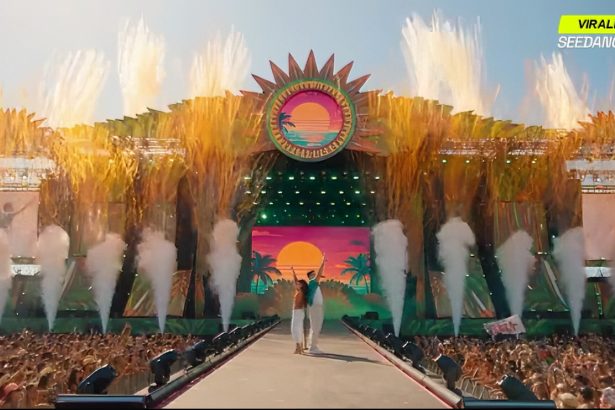
Rock music split down the middle in 1969. Rock was still viewed as a revolutionary political force at the Woodstock Music Festival in August of that year, when half a million young people danced and grooved for three days of peace, love, and mud. But only four months later, rock's humanitarian ideals went up in smoke at the disastrous free concert at Altamont Speedway near San Francisco: The Maysles brothers' 1970 film, Gimme Shelter, documents the bad vibes, fistfights, and finally a murder in front of the stage as the Rolling Stones performed. The utopian hippie era, typified by 1967's Summer of Love and Monterey Pop Festival, was over.

Led Zeppelin, the band that would dominate the '70s, arrived in 1969 with two blockbuster debut albums (Led Zeppelin in January and Led Zeppelin II in October). This British band broke up the mass audience for rock that had been created by Elvis Presley and consolidated by the Beatles. Along with Black Sabbath (Ozzy Osbourne's band; debut album 1970), Led Zeppelin gave birth to deafening arena rock and heavy metal, whose cult following were called headbangers--desperate, alienated young men who beat their heads on the stage edge in sync with the band's thundering power chords. Gentle Flower Power rock was vanishing. Most women rock fans were slow to appreciate heavy metal.

In 1969, the Beatles performed together for the last time (on the roof of their Apple headquarters) and recorded and released their final album, Abbey Road. (Let It Be was recorded earlier in 1969 but released a year later.) As in 1968's White Album, Abbey Road displayed the wildly diverging tastes of the Fab Four, now bitterly fighting. The Beatles were disintegrating, just as the rock audience was fragmenting into what would become today's niche music markets. The breakup of the Beatles, announced by Paul McCartney in April 1970, was prefigured by a bizarre "Paul is dead" rumor that swept the world in October 1969.

Yet the dream of unity lingered: In March 1969, the fast-selling Broadway cast album of Hair ("America's First Tribal Love-Rock Musical"), released the prior year, won a Gold Record Award. Two of its songs became huge hits in 1969: the Cowsills' comic "Hair" and the 5th Dimension's "Aquarius/Let the Sunshine In," with its mystic vision of human solidarity.

Hopes still ran high for rock as art, as shown by the 1969 release of the Who's Tommy, Pete Townsend's agonized memoir of his wartime childhood. This propulsive double album, billed as a "rock opera," was rock's challenge to classical music. Tommy became a campy 1975 movie, directed by Ken Russell and starring Ann-Margret as the mother of the deaf, dumb, and blind boy, and Tina Turner as the Acid Queen. But rock opera went nowhere.

Bob Dylan, who had brilliantly fused folk music with electric rock, had now abandoned rock. His 1969 album, Nashville Skyline, continued the country-and-western style of his prior release, John Wesley Harding (1967), which represented a startling change of persona after his 1966 near-fatal motorcycle accident. But others, like Crosby, Stills & Nash, were determined to push folk-rock forward: This supergroup, formed in California in 1968, released a first album in 1969. With the addition of Neil Young, they sang at Woodstock and adopted a radical political stance. Despite their angelic vocal harmonies, however, this band was even more quarrelsome than the Beatles, and split up in 1970--only to reunite and break up repeatedly over the next three decades.
Southern rock, a major trend of the '70s, was born in 1969 with the magnificent blues-based debut album of the Allman Brothers Band. The Allmans had passion and depth, but the band's artistic promise was dimmed by the death of two of its members in motorcycle accidents: sensational lead guitarist Duane Allman in 1971 and bass player Berry Oakley the next year. The drug problems of Gregg Allman, the lead vocalist and organist, would go public after his 1975 marriage to Cher.

In 1969, David Bowie came to international attention with his eerie single "Space Oddity": As his psychedelic astronaut, Major Tom, floats helplessly into outer space, we sense that the '60s counterculture has transmuted into a hopelessness about political reform ("Planet Earth is blue/And there's nothing I can do"). In the 1970s, Bowie's avant-garde androgyny would counter Led Zeppelin's phallic strutting.

One band was at creative maturation in 1969: The Rolling Stones released Let It Bleed (satirizing the Beatles' stuck-in-production Let It Be), containing "Gimme Shelter" and "Midnight Rambler." It was Brian Jones's last album. Once the leader of the Stones, he had sunk into drugs and drink and was displaced by Mick Jagger. In July 1969, Jones was found dead in a swimming pool at his country estate. Two days later, before the Rolling Stones' gigantic free concert at London's Hyde Park, 3,000 white butterflies were released. Then Mick Jagger, wearing a mutton-sleeved white dress over pants, shakily read a Shelley poem. It was an elegy not just for Brian Jones, but for the optimistic '60s.


BNET TalkbackShare your ideas and expertise on this topic

Please add your comment:

  1. You are currently: a Guest |
  2.  

Basic HTML tags that work in comments are: bold (<b></b>), italic (<i></i>), underline (<u></u>), and hyperlink (<a href></a)

advertisement
Click Here
advertisement
  • Click Here
  • Click Here
  • Click Here
advertisement

Content provided in partnership with Thompson Gale