Featured White Papers
- Oct. 14th: Simplified IT with Software-as-a-Service (SaaS) (ZDNet)
- PCI DSS therapy for the smaller retailer (McAfee)
- The rise of Web commuting (Citrix Online)
We are all Panamanians - formation of Isthmus of Panama may have started a series of climatic changes that led to evolution of hominids
Discover, April, 1996 by Kathy A. Svitil
The emergence of the Isthmus of Panama has been credited with many milestones in Earth's history. When it rose from the sea some 3 million years ago, the isthmus provided a bridge for the migration of animals between North and South America, forever changing the fauna of both continents. It also blocked a current that once flowed west from Africa to Asia, diverting it northward to strengthen the Gulf Stream. Now Steven Stanley, a paleobiologist at Johns Hopkins, says that that change in currents may be behind yet another major event: the evolution of humans. When the isthmus rearranged the ocean, he says, it triggered a series of ice ages that in turn had a crucial impact on the evolution of hominids in Africa.



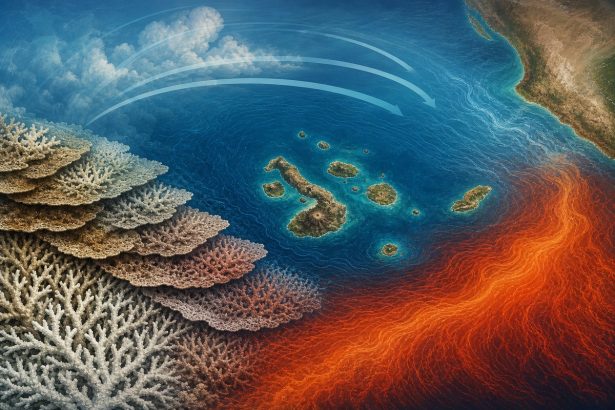
Stanley's hypothesis, which he describes in a new book called Children the Ice Age, is based on ideas developed by a number of oceanographers over the past decade, notably Wallace Broecker of the Lamont-Doherty Earth Observatory. Broecker has called attention to the climatological implications of a fundamental difference between the Atlantic and the Pacific: the Atlantic is much saltier. The difference arises in part because of the dry trade winds that blow west off the Sahara Desert, evaporating water off the ocean and leaving salt behind. "The trade winds are thirsty, and they pick up a lot of moisture from the Atlantic," says Stanley. "Much of that moisture is carried over into the Pacific and drops into the ocean. So the salinity is quite low on the Pacific side of the Isthmus of Panama, but very high on the Atlantic side."
The result is a global system of ocean currents called the conveyor belt. As salty water moves north in the Atlantic - carried by the Gulf Stream, for instance - it gets colder. The combination of extra saltiness and cold temperatures makes the water especially dense - and especially prone to sinking. In the vicinity of Iceland the salty water sinks to the ocean floor. From there it spreads southward to Antarctica, converges with another sinking current, and loops through the Indian Ocean and into the Pacific. There the water wells back up to the surface and slowly returns to the Atlantic around the tips of South America and Africa.
The entire conveyor belt, the theory goes, is driven by the sinking of water in the Atlantic, and ultimately by the salinity difference between the Atlantic and the Pacific. ("The water of the North Pacific gets just as cold as the Atlantic in winter," Stanley says, "but it doesn't sink, because the Pacific is less salty, and therefore more buoyant." And before the Isthmus of Panama formed, Stanley argues, the conveyor belt didn't exist. Atlantic water flowed directly into the Pacific between the Americas, reducing the salinity difference. The water that then flowed into the North Atlantic, however, wasn't salty enough to sink into the deep ocean; instead it continued northward to the Arctic. Therein lies the key, in Stanley's view, to how the isthmus may have affected human evolution.
As long as North Atlantic waters flowed into the Arctic, he says, they kept it relatively warm - warm enough, for instance, that marine species from temperate climes, like the blue mussel, could use the Arctic to migrate from the Pacific to the Atlantic. After the isthmus formed, however, the conveyor belt denied the Arctic those warm waters, "and because the sun strikes at such a low angle up there," Stanley says, "it got very cold." Pack ice soon formed, which reflected the sun's rays, chilling the region still further. Soon the influence of the frigid north spread inexorably south, as did the glaciers, and the Ice Age began - a long period of waxing and waning ice sheets from which we have yet to emerge.
The impact of the Ice Age was most strongly felt in the higher latitudes, but it also made Africa colder, windier, and drier. Many researchers have suspected that these changes spurred the evolution of Australopithecus, the earliest hominid. As Africa cooled and dried, this school of thought contends, the habitat of Australopithecus changed. "Before the Ice Age began, there was probably a very broad zone of open forests on the fringe of the rain forest that was accessible to Australopithecus, " Stanley says. When the world cooled off, however, the rain forest shrank, while desert and grassland regions expanded. That's a big problem if you're an australopithecine living a semiarboreal life in a forest habitat. "It must have been a tremendous crisis," Stanley says. Australopithecus had to survive on the ground and evolve mechanisms that would allow it to do so. Sometime after 3 million years ago, it branched into two lineages - strong-jawed Paranthropus and big-brained Homo.
As it happens, there is now strong evidence linking that evolutionary split to a climate change in Africa. The evidence was reported last year by paleoclimatologist Peter deMenocal of Lamont-Doherty, who studied marine sediment cores drilled off the African coast. The cores contain dust blown off the neighboring continent, so they provide a record of how dry it was there when each layer of sediment was laid down - a colder, drier climate made for more dust. Over the past few million years, the African climate has oscillated continually between periods that were relatively cold and dry and ones that were warmer and wetter. But around 2.8 million years ago, the sediment cores show a pronounced change. The duration of the cold-warm cycles increased, from an average of around 2 3,000 years to 4 1,000 years. And judging from the increased amount of dust in the sediment, the cold periods got markedly colder and drier.