Featured White Papers
- Sept. 11th: PCI DSS therapy for the smaller retailer (McAfee)
- Enterprise PBX comparison guide (VoIP-News)
- Enterprise PBX buyer's guide (VoIP-News)
Automotive Industry
Industry: Email Alert RSS FeedRecharging EVs: Valence Technology Inc. thinks its phosphate-based lithium ion batteries could put new spark in the EV industry
Automotive Industries, Feb, 2005 by John Peter
Don't pull the plug on the electric car yet. Valence Technology Inc. of Austin, Texas, has a battery technology that just may revitalize electric vehicles, as well as improve the development of both hybrid-electric and fuel cell-powered cars.

Saphion is a phosphate-based lithium ion battery technology. Lithium ion batteries are beginning to show up in concepts like General Motors' Sequel fuel cell crossover SUV, replacing Nickel-metal hydride batteries (NiMH). Phosphate-based lithium-ion technology solves one of the biggest concerns with today's oxide-based lithium-ion batteries, and that's safety. In the event of an accident or failure, oxide-based lithium-ion batteries, release oxygen that can create a fire, or worse yet, an explosion. Phosphates are extremely stable in overcharge or short circuit conditions and have the ability to withstand high temperatures without decomposing, so the threat of fire or explosion is eliminated.

Unlike traditional lithium-ion materials like cobalt or magnesium oxide, and the nickel in NiMH batteries, for that matter, phosphate batteries are ecologically safe. In fact, Saphion batteries are landfill-approved in the state of Nevada where Valence's R&D center is located.
There are several other benefits to using Saphion over traditional technologies. Saphion batteries have a run-time three to four times longer than lead acid or NiMH batteries.
Valence has breathed new life into the Segway two-wheeled personal transportation device. When Segway replaced the NiCD or NiMH batteries they currently use with Saphion lithium-ion batteries, operation time between charges was doubled from four hours to eight.
"It's the difference, for Segway, from being nowhere to being able to go into real commercial applications that require full-day usage," says Stephan Godevais, chairman and CEO of Valence. "That was a big breakthrough for them."
Valence recently announced that Alternativ Canada, a company that retrofits gasoline-powered cars into EV applications, replaced the lead-acid batteries in one of its Hyundai Accents with Valence's U-Charge phosphate lithium-ion batteries. By using Saphion technology, Alternativ Canada was able to extend the range of its vehicles from 35 kilometers to over 100 kilometers on a single charge.
U-Charge is packaged in the same space as a traditional lead-acid battery and hooks up the same way. Saphion batteries are maintenance free and, according to Valence, will last the lifetime of the vehicle. Charging time is similar to nickel-metal hydride. And unlike lead acid batteries, lithium-ion batteries don't fail suddenly, they fail over a very long period of time.
And as an added benefit, since phosphate lithium-ion technology uses no heavy metals, the batteries weigh less.
Godevais says that weight is one of two advantages over the NiMH batteries used in today's hybrid-electric vehicles.
"We could probably drop half the weight out of the battery, or keep everything the same and double the amount of energy," Godevais says.
Godevais also points out that NiMH batteries are greatly affected by heat.
"They don't like to be charged when it's hot, where our technology can accept fast recharge rate, can discharge quickly and is not affected by heat as nickel-metal hydride is."
Valence is concentrating its global efforts in two areas, full EVs and series, or plug-in hybrid-electric vehicles.
"We're working with French manufacturer Dassault," Godevais says. "They're the guys who make the Mirage fighter plane. They want to have an aggressive EV program. We're also working with a company In the Netherlands called E-Traction that does electric buses."
Valence has also piqued the interest of the taxicab market. The company is currently working with one company that has a deal with the State of California to do a trial with some electric taxi cabs for the city of Sacramento, Calif.
"And you can imagine in New York instead of adding taxicabs that are gas-based but are electric based, that way New York would live a lot better," Godevais says, "So there is a lot of application."
"The interest in the U.S. is plug-in hybrids," says Mark Kohler, business allotment manager for automotive applications.
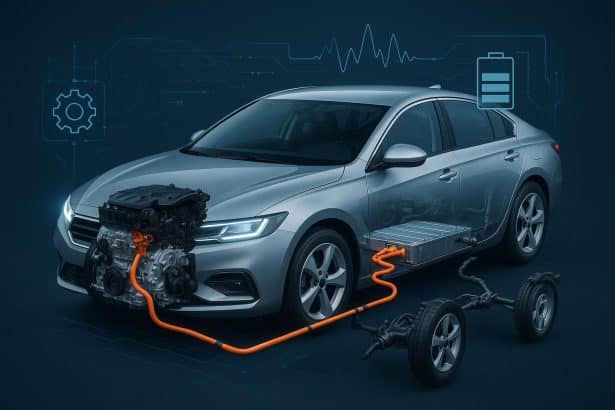
In a plug-in or series hybrid, the gasoline engine is only used to charge the batteries allowing the vehicle to run for longer periods in electric-only mode, increasing fuel mileage from 40 to 50 miles per gallon to as much as 100. It also offers the option of plugging the vehicle in to charge the batteries.
"It's kind of a crossbreed between a full electric and a hybrid," Kohler says. "So you get the best of both worlds. I think in the U.S. EVRAY and other large organizations are looking toward a plug-in hybrid solution."
Kohler says that there's a big movement in California to retrofit out-of-warranty Toyota Prius as series hybrids when the batteries need to be replaced. One of Valence's customers, Energy CS, of Monrovia, Calif., uses Saphion batteries to do just that.