Manufacturing Industry

Turning wheat straw into particleboard; the market potential of composite panels made from wheat straw has caught the eye of at least a half-dozen manufacturers

Wood & Wood Products, Jan, 1998 by Mark Rich

The market potential of composite panels made from wheat straw has caught the eye of at least a half-dozen manufacturers.

SAUDER WOODWORKING AND VT INDUSTRIES manufacture two different types of products -- RTA furniture and kitchen components, respectively. Yet both companies have committed to purchasing 80 percent of the wheat-straw particle-board that will be produced by Isobord when it opens its plant in the Canadian town of Elie, Manitoba, in the fall of 1998.

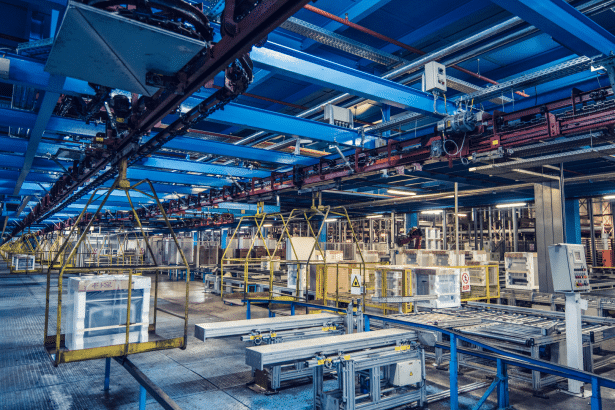
The new plant has a guaranteed output of 130 million square feet of product on a 3/4-inch basis, with 144 million square feet the expected output.

So why have these companies committed to this new product?

"One, early indications show it seems to have the uniformity characteristics of MDF yet with a particle board price," said Kevin Sauder, director of marketing for Sauder Woodworking. "Second, it ensures another source of supply that isn't tied to the spotted owl. The long-term supply seemed to be strong, and we felt it was best to encourage that.

"Third, it has some moisture resistance attributes for any kitchen applications or vanities, or for international sales in hot and humid climates."

"It's the attractiveness of the renewable resource type of board," said John Fell, corporate purchasing manager for VT Industries. "That's going to relieve some pressure on our forests.

"People are more and more concerned over the impact on the environment, and we feel this is much better, not having to rely on wood byproducts."

Particleboard made with agricultural products is becoming more and more popular as wood becomes more and more scarce and expensive.

Wheat-straw particleboard is made in much the same way traditional particleboard is, with straw chopped into uniform fiber and often mixed with formaldehyde-free MDI resin to create the board.

In addition to Isobord's plant, at least six other companies are currently producing or have future plans to produce wheat-straw particleboard:

* PrimeBoard of Wahpeton, ND, began production of WheatBoard in June 1995. Its plant has a capacity of 30 million square feet of board per year, and the company is planning an expansion which will bring capacity to 60 million square feet per year.

* Naturall Fibre Boards of Minneapolis, KS, produces Wheat Sheet, a board created from wheat fiber strands mixed with a bonding agent. The plant, located in Minneapolis, has been in operation since August 1995. The 30,000-square-foot plant produces between 600 and 1,000 4 by 8 panels per day.

* CanWel produces Compakboard, a straw-based board, at its 90,000-square-foot Cenkan plant in Hutchinson, KS. The facility produces 4.5 million feet of board in an average month.

* Alta Goldboard is scheduled to begin construction of a plant on a 650-acre site east of the Village of Thorhild, AB, in the spring of 1998, with planned production beginning in the fall of 1999. The plant's capacity is expected to be 345,000 cubic meters per year on a 3/4-inch basis.

* AgraFibre is currently building a strawboard plant near Wanham, Alberta, which is scheduled to begin production in December 1998. The annual capacity of the plant is expected to be 62 million square feet on a 3/4-inch basis.

* Phenix Biocomposites is currently building a 200,000-square-foot plant in Mankato, MN, which is scheduled to begin production of Biofiber wheat particleboard in late fall of 1998. The plant is expected to produce 40 million square feet of either wheat or soybean Biofiber board on a 3/4-inch basis annually. Phenix is also developing plans to place three additional wheat-straw board plants in South Dakota over a three-year span starting in 1999.

New Kids On the Block

With this influx of fiber-based particleboard producers, the Composite Panel Assn., whose 31 members make UP more than 85 percent of particleboard and MDF capacity in North America, has put out the welcome mat for these companies to join it.

"We consider straw particleboard to be part of the overall panel family," CPA President Rich Margosian said. "We think that strawboard is a viable product. It's basically unproven in the marketplace at this time, but we see no reason it shouldn't work. Traditional (particleboard) producers are opening the association forum to strawboard manufacturers because we believe that their success or failure will have an impact on the rest of the industry.

"The final consumer will not be able to discern whether he's getting a wood-based particleboard or an agricultural particleboard. If something goes wrong with the (strawboard) products, all (particleboard) products would be colored by that, so its in our interest to bring them into the family and work with them."

Although he sees the new companies as a viable part of the composite panel industry, Margosian said he still is not sure how well they will do.

"It's going to be a learning process for these folks," Margosian said. "All of the (strawboard plants) operating currently are quite small, and they haven't been operating for more than a year or two. There's not a lot of product out on the open market yet, so the jury is still out.

 
Comment on Article

BNET TalkbackShare your ideas and expertise on this topic

Subscribe to this discussion via Email or RSS

  •  
    1

    Krinio

    07/22/09 | Report as spam

    RE: Wood & Wood Products

    I am an artist who would like to use strawboard for a support
    to paint on. Do you manufacture boards between 1/8 to 1/4"
    thick, and would they be obtainable in the UK?

Please add your comment:

  1. You are currently: a Guest |
  2.  

Basic HTML tags that work in comments are: bold (<b></b>), italic (<i></i>), underline (<u></u>), and hyperlink (<a href></a)

advertisement
advertisement
  • Click Here
  • Click Here
  • Click Here
advertisement
Click Here

Content provided in partnership with Thompson Gale