Business Services Industry
Offices vs. open space: deciding whether to tear down the walls or build them up isn't always an open-and-shut decision - Cover Story
HR Magazine, Sept, 2002 by Robert J. Grossman
Experts agree that there is no one-size-fits-all formula for designing the ideal workplace. However, they fall into two deeply divided camps when it comes to a fundamental aspect of apportioning space: One group proselytizes for a return to private offices, the other promotes completely open offices.
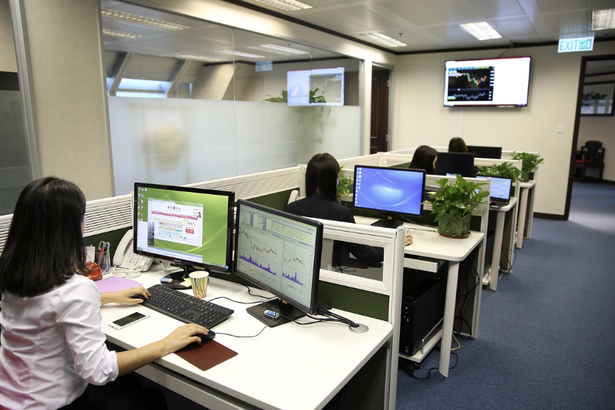
Interestingly, these groups are united in their disdain for what some might consider a compromise position--cubicles, the office environment most commonly used by employers. Currently, an estimated 70 percent of workers spend their time in cubicles.
"They provide pseudo-privacy at best, and are terrible for spontaneous communication," says Franklin Becker, director of the International Workplace Studies Program at Cornell University.
More Articles of Interest
- A humanistic approach to space - office designs - includes related articles -...
- Wide open spaces: cubicle-ridden offices transition to more open-office...
- 'bullpens' preferred over cubicles, private offices
- Shaping the office of the future
- In some offices, open space is replacing the cubicle culture
"Cubicles are acoustic sieves that intrude on your thoughts and conversations," agrees Michael Brill, president of BOSTI Associates, a workplace planning and design consultant in Buffalo, N.Y., and founder of the School of Architecture at the University of Buffalo.
But that's where the agreement ends for these two experts.

Becker believes cubicle walls should come down. "Usually, you can't see the person in the cube next to you unless you stand up," he says.
Currently, 10 percent of offices are completely barrier-free, with no partitions separating workstations, estimate experts. In these environments, everyone-including the bosses-sits in the open on rollable chairs arranged in clusters or rows in bullpens.
In some workplaces, the private office still reigns as the primary means of allocating space-especially for those higher in the hierarchy. Overall, however, offices are becoming less common as companies squeeze funds from their facilities budgets. But Brill believes that private offices-- even small ones--pay dividends for all workers by creating a more productive work environment.
HR professionals and facilities administrators caught between these two diverging opinions can easily become confused about whether one setup is generally better suited than another to their workplace. Ultimately, you'll need to take a close look at your organization's s needs, processes and culture and decide for yourself.
Privacy vs. Collaboration
Brill studied the impact of the work environment on work satisfaction and performance for more than two decades. Working from a database of 13,000 people in 40 organizations, he's identified the 10 most important predictors of job performance. The top two are:
1. The ability to do distraction-free work for teams and individuals.
2. The ability to have easy, frequent, informal interactions.
On average, when these factors were addressed at the 40 organizations studied, individual performance jumped 4 percent to 5 percent, team performance 23 percent. Job satisfaction rose 23 percent.
For Brill, the equation is simple: Workers spend the majority of their time in private or near-private activity. As a result, he advocates giving each person a private office, no matter how small.
In addition, most meetings--unscheduled, usually involving two or three people--occur at the workstation. Private spaces encourage impromptu, confidential conversations--which are the "backbone" of an organization, according to Brill.
"We've been experimenting with acoustically private offices that are 50-60 square feet with sliding glass doors--substantially smaller than the traditional private office. These new 'cocktail' offices are interspersed with or surround an open team area just outside the individual doors. The design permits people to do distraction-free work by keeping the door shut. If they choose, they can keep the door open, or step right outside to the collaborative space.
Collaboration Trumps Privacy
Though privacy is important, Becker believes that promoting collaboration is at the core of good office design. Becker's studies reveal that workers spend most of their time with their teams and go to private places only as needed.
As a result, he recommends a series of small-scale four- to eight-person "war rooms" or team offices. They can be in a room fully enclosed or clustered in a larger space. "There are times when someone needs total privacy, but no one works eight hours a day in the total concentration mode. You work in spurts; so you need to have the chance to get privacy when you need it."
He cites a University of Michigan study in which two teams of software developers at Ford Motors were separated. One team was given private offices, the other assigned to war rooms. The group in the war rooms was twice as productive.
He also cites research showing hat private offices can kill inter- group collaboration. "In a survey of 2,000 employees, we found that the likelihood that you'll have contact outside your group drops dramatically when you have a private office," he says.
Reading Between the Lines
In an attempt to decide if public or private spaces are best suited to their particular business and workforce, some employers have adopted an intuitively logical approach: They ask workers what they prefer.
Most Recent Business Articles
- Multiple criteria evaluation and optimization of transportation systems
- Multi-criteria analysis procedure for sustainable mobility evaluation in urban areas
- A two-leveled multi-objective symbiotic evolutionary algorithm for the hub and spoke location problem
- Multi-criteria analysis for evaluating the impacts of intelligent speed adaptation
- The development of Taiwan arterial traffic-adaptive signal control system and its field test: a Taiwan experience
Most Recent Business Publications
Most Popular Business Articles
- 7 tips for effective listening: productive listening does not occur naturally. It requires hard work and practice - Back To Basics - effective listening is a crucial skill for internal auditors
- FAS 109: a primer for non-accountants - Financial Accounting Standards Board's "Statement 109: Accounting for Income Taxes"
- Design a commission plan that drives sales - Sales Commissions
- Too Young to Rent a Car? - 25-years-old the minimum age for car renting - Brief Article
- LIFO vs. FIFO: a return to the basics