Environmental Displacement: Coordinating Efforts to Find Solutions
Georgetown International Environmental Law Review, Spring 2006 by King, Tracey
I. INTRODUCTION
The recent film The Day After Tomorrow reveals a Hollywood version of a very real problem. After scientists discover a devastating storm caused by global climate change developing over the United States, the government evacuates the southern half of the United States. Hundreds of millions of people flee and settle in crowded refugee camps throughout Mexico.1 The film illustrates the potentially disastrous consequences of mass displacement caused by environmental crises.
In reality, severe environmental degradation increasingly causes displacement around the world. Deteriorating environmental conditions such as deforestation, global warming, and resource pollution compel many families to move to safer locations. The brunt of the impact is felt in many of the poorest nations, where governments and individuals have few resources to respond to environmental damage and the consequential migration.2
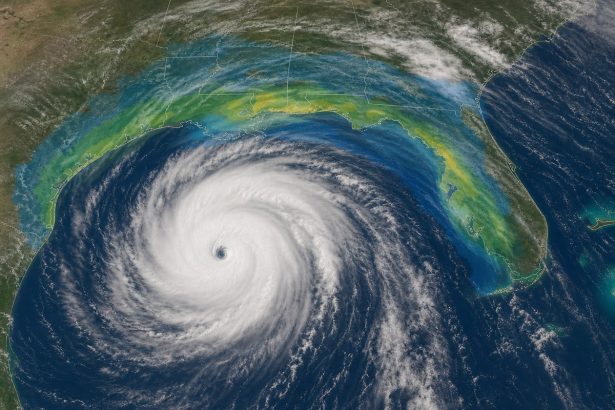
Although the number of people migrating for environmental reasons is difficult to estimate, Norman Myers, an Oxford University ecologist, estimated in 1996 that twenty-five million people were environmentally displaced, compared to twenty-three million displaced by civil war and persecution.3 He further predicted that the number of environmentally displaced persons would double by 2010 and dramatically increase when the effects of global warming are more significantly felt, leading to as many as 150 million environmentally displaced persons by 2050.4 Recent natural disasters provide tragic real-world examples of environmental displacement. Although statistics vary, some estimate that the 2004 tsunami in Asia displaced over 1.8 million persons, including more than 645,000 in India and 600,000 in Indonesia.5 Hurricane Katrina displaced over one million people on the Gulf Coast of the United States,6 and the 2005 earthquake in South Asia left over three million people homeless.7
Currently, international organizations are unable to effectively address this problem due to a lack of coordination. While various organizations work to protect and rehabilitate the environment, mitigate the effects of displacement, and assist and resettle displaced persons, they do so without necessarily coordinating their efforts to receive the greatest benefit. This note proposes a mechanism that coordinates the efforts of the various organizations that address facets of environmental displacement, thereby maximizing their effectiveness.
Part II describes the problem of environmental displacement. It discusses the various roles that environmental damage may play in causing migration and categorizes environmentally induced population movements using a typology based on speed of onset and possibility of return. Part III describes the individuals that migrate for environmental reasons, distinguishing between refugees, environmental migrants, and environmentally displaced persons. This part first describes the current legal definition of a refugee and argues that this definition does not and should not include most individuals that migrate for environmental reasons. It continues by distinguishing between environmental migrants and environmentally displaced persons, the former similar to other migrants and the latter similar to refugees. Finally, it argues that the international community should protect environmentally displaced persons because they are particularly vulnerable and powerless.
Part IV argues that the international community should work to address the problem of environmental displacement for humanitarian, equity, global security, and environmental reasons. International coordination is necessary to address this complicated issue that spans a number of traditional fields. Part V accordingly introduces a mechanism that would coordinate current work on the environment, development, migration, refugee protection, and humanitarian assistance. This mechanism would work to protect both the environment and persons displaced by environmental degradation, focusing on five program areas: prevention, preparedness, mitigation, rehabilitation, and resettlement. Environmental displacement affects millions of people and is likely to affect more in the near future if we continue on the same path. The international community should work together to solve this critical problem.
III. ENVIRONMENTALLY INDUCED POPULATION MOVEMENTS
Environmental degradation or damage is a significant cause of environmentally induced population movements. Because the decision to move is often guided by a number of influences, environmental problems may work in concert with other factors to encourage or compel movement. Depending on the form of environmental change, movements can be categorized according to speed of onset and the possibility of return.


A. THE ROLE OF ENVIRONMENTAL CHANGE IN POPULATION MOVEMENTS
Migration is often the result of a complex web of factors, such as the availability of sufficient resources to move, the presence of family within the sending and receiving countries, and the level of information available about the receiving country. Environmental degradation or damage may play one of several roles in influencing an individual's decision to move.
Most Recent Reference Articles
- ARAB EUROPEAN RELATIONS - Dec 22 - Russia Denies Selling Missile System To Iran
- EGYPT - Dec 29 - Opposition Says Mubarak Blessed Israeli Attacks
- ARAB AFFAIRS - Dec 22 - Syria Will Eventually Move To Direct Talks With Israel
- ARAB AFFAIRS - Dec 30 - GCC Denounces Massacre
- ARAB ISRAELI RELATIONS - Israel Issues An Appeal To Palestinians In Gaza
Most Recent Reference Publications
Most Popular Reference Articles
- Credit card debt on college campuses: causes, consequences, and solutions
- 9 questions to ask your new lover: what you were afraid to ask, but always wanted to know
- How Tyler Perry rose from homelessness to a $5 million mansion
- Rejoice anyway - Zephaniah 3:14-20, Philippians 4:4-7 - Living by the Word - Column
- Living by the word