Cyborgs and Atomic Microscopes

Phi Kappa Phi Forum, Spring 2004 by Gualtieri, Devlin M

Much discussion is currently taking place about the ethics of intentionally modifying the human species. Fifty years ago, this same discussion was taking place, but it was not about intentional modification of DNA (the structure of which had just been discovered by Crick, Franklin, Watson, and Wilkins to be the basis of life); instead, it was about creating a hybrid of man and machine - that is, a cyborg.


The word "cyborg," shorthand for Cybernetic Organism, was introduced by Manfred Clynes in 1960. Nowadays we seldom hear the word, and we are even less likely to hear about cybernetics, although advances in nanotechnology may someday make cyborg a household word. Cybernetics as a field of study has been eclipsed by "Artificial Intelligence," a field of computer science enabled by the evolution of powerful digital computers. The study of artificial neural networks is essentially all that is left of cybernetics. Most of those studies now conform to an artificial-intelligence paradigm, in which intelligence is considered to be a quality that can be stored, rather than the cybernetic definition that considers intelligence to be an interaction.

The word "cybernetics," from the Greek word for steersman, was coined by Norbert Wiener in 1948. Wiener was a brilliant mathematics professor at MIT who used the term to describe the study of autonomous machines, especially those that incorporate a feedback mechanism to survey their surroundings and respond to it. Those were the days before ubiquitous digital computers, and Wiener's autonomous systems were simple electronic systems that performed such tasks as aiming artillery, an important application that he studied during World War II. Earlier, simple mechanical systems, such as the speed governor on steam engines, had performed a similar control function that amounts to simulating the actions of a human operator. Wiener, in his 1950 book, Human Use of Human Beings, proposed cybernetic machines as a way to free humans from many of the less interesting tasks of life, such as tending the hearth to achieve a comfortable room temperature.

The idea of a cyborg takes cybernetics a step further by making humans a part of a more efficient machine. Cyborg was likely the inspiration for the naming of the Borg in Star Trek: The Next Generation, and the idea of a human-machine hybrid does conjure images of the Borg for most people. The Borg, as hybrids of human and machine, have lost their humanity in proportion to the loss of human flesh. The Star Trek humans resist assimilation by the Borg because they see this conversion as a loss of their essential humanity. When I was a boy, an article was published in Life magazine about cyborgs. One image that I remember is a cyborg astronaut floating nearly naked in space with a fishbowl on his head. At that time, Clynes and his colleague, Nathan Kline, were investigating cyborg technology for NASA as a way for humans to conquer space, but one look at that illustration makes you wonder whether it was really humans doing the conquering.

The question of how much of the human remains in a cyborg leads us to the Socks Paradox. A particular sock is darned with new thread whenever it gets a hole. Eventually, all thread that was in the original sock has been replaced. Is it still the same sock? If not, when did it lose its identity? The Greek philosopher Heraclitus, who wrote that you cannot step into the same river twice, would answer that the sock is always a different sock, not just after the first stitch, but after the first crease. At any instant the sock is never identical to one at a particular past instant. Heraclitus would argue that we do not maintain our identity from one instant to the next because we age, lose a hair here or there, and so on. It seems that Heraclitus would have no problem with human transformation into cyborg because a human is always changing, and there is no reference state for the definition of what is called human.

Modern humans have always been cyborgs to some extent. From the time that we first donned cloak and shoes, we have used mechanisms to enhance our lifestyle. After clothing, more complicated artifacts were introduced. Eyeglasses were developed for better vision, but we did not stop there. Instead of merely alleviating a deficiency, we found ways to enhance functionality. So eyeglasses led to telescopes, and written language evolved as a memory-enhancement tool. Medical and scientific instruments are the culmination of mechanisms to enhance our senses. As such instrumentation becomes more complex and what is sensed becomes very distant from the human state, are we really sensing things as humans, or can such sensing be understood only in the context of the human-machine hybrid, a cyborg?

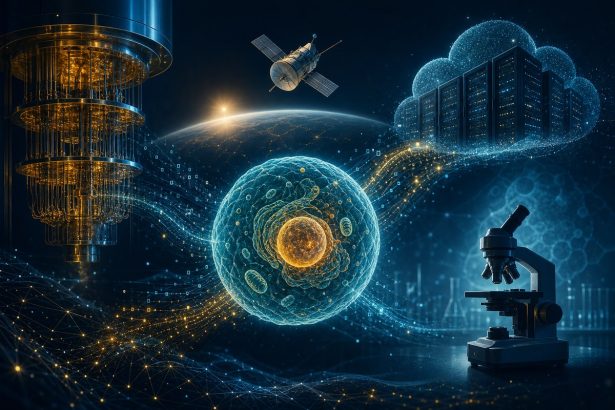
Atomic Force microscopes now exist that can image individual atoms on the surface of solids, so some scientists claim to be seeing atoms. One is reminded of the painting of a pipe by the Belgian surrealist painter, Rene Magritte, with the caption, Ceci n'est pas une pipe (This Is Not a Pipe, 1926). What we see in the Magritte painting is not a pipe, but a representation of a pipe, and Magritte explicitly makes this point. When you view a small object with an optical microscope, you actually do see the object because the microscope is just an amplifier for the light that reaches your eyes. However, an atomic force microscope is not an amplifier of anything that can be seen, and the image of atoms viewed on a computer display is merely a representation of atoms with no direct linkage to human senses. The cyborg scientist, a combination of human and the atomic force microscope machine, claims to see atoms, but he or she is not seeing in the human sense.


BNET TalkbackShare your ideas and expertise on this topic

Please add your comment:

  1. You are currently: a Guest |
  2.  

Basic HTML tags that work in comments are: bold (<b></b>), italic (<i></i>), underline (<u></u>), and hyperlink (<a href></a)

advertisement
advertisement
  • Click Here
  • Click Here
  • Click Here
advertisement

Content provided in partnership with ProQuest